7.23.2006

Blundering Through Israel - Part VII - July 2, 2006

Continued from Part VI

Today was Masada. To anyone who had heard the phrase "snake path," that is all that needs to be said.

For the uninitiated, climbing Masada is the practical equivalent of going to the gym when you really don't want to, but feeling really good and proud of yourself afterward. Times ten thousand. On both ends.

Masada was a city-fortress atop a mountain created by King Herod. In 70 B.C.E., a small group of religious zealots took refuge there after the Romans destroyed the Second Temple. After two years of trying, the Romans seized the fortress by building a ramp to the top on the back of the mountain.

As the Romans breached the defenses, the Jews at Masada made a decision that distinguished them from many other Jews. They decided that, rather than suffer the imminent torture of humiliation of Roman punishment and slavery, they would engage in a mass suicide, dying free.

The 45-minute (45. Yeah. Right.) climb up Masada was bright and early, in order to avoid in the intense summer desert heat.

Climbing Masada is like using a stairmaster. A stairmaster on steroids. Lots of steroids. When you're asleep.

Seriously.

But the physical pain of climbing the mountain is nothing compared to the perplexing questions that confront you at the top.

Masada is more than a national landmark. It is part of the Jewish zeitgeist. The idea of Jews killing themselves rather than facing slavery and humiliation is incredibly romantic to the Jewish community.

But is it really a sign of strength?

One fact brings this issue to the forefront for me: There are no descendents of the Jews of Masada.

Consider the possibility that Jews of the Holocaust simply committed mass suicide rather than suffer the unspeakable atrocities of the concentration and death camps. While some did, the majority did not. And it is the children and children's children of the survivors, those who relied on hope and faith rather than pride and glory, who make up the world's Jewish communities today.

So who is stronger, the person who bears the torture and humiliation in the hope of survival or the person who kills himself, and his yet to be born descendants, to preserve the dignity of avoiding it?

And doesn't a Jew who kills himself complete the goal for the anti-Semite by expediting his work?

Isn't living the real act of resistance?

And if so, aren't the survivors the real martyrs?

If this is the case---if the attempt to live is more honorable than the act of death by one's own hand to avoid humiliation and servitude---then why is Masada a source of pride? Why is Masada so highly revered? Why do entire families go to the top of the mountain to have their bar mitzvot in the ruins of the Masada synagogue? Why did I feel such a connection to the past when I prayed in that same synagogue? Why should we revere those who contradicted not only Jewish law, but the principal Jewish value---any law can be broken to save a life?

And yet we do. We sing songs of our pride in Masada. We tell the story as one of resistance and sacrifice, not one of shame.

Yeah.

With questions like these, that climb seems pretty easy.


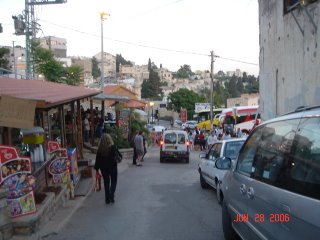
Masada from the ground (admittedly a little blurry)...

A model of Herod's Northern Palace...

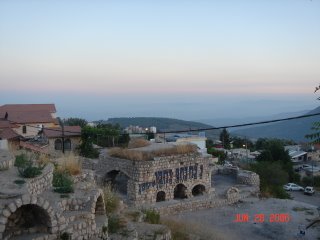
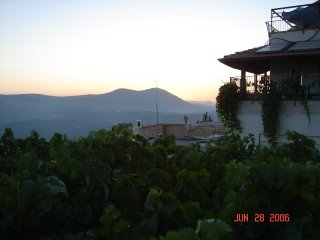
The view from where it stood today...
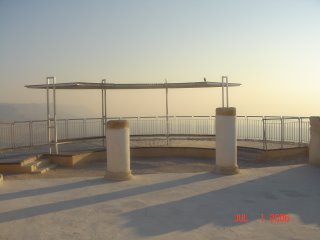
Davening morning prayers at the synagogue atop Masada...

The ramp built by the Romans to breach Masada. You can see the Roman encampments at the top and the top right...

A model of the bathhouses...

The bathhouse ruins...


The false floors of the bathhouses...

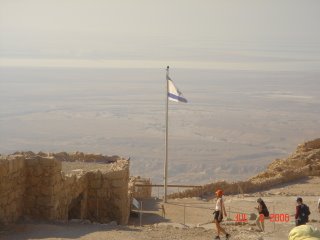
The Israeli flag, flying atop Masada, as a symbol that it will never again be conquered...
7.22.2006

Blundering Through Israel - Part VI - July 1, 2006

Continued from Part V

While the rest of my group is exploring the Old City of Jerusalem, I've taken the "optional activity" to optionally leave the tour and fulfill an eight year old promise.

The last time I was here was three days after my little brother left. He spent a year in Israel, studying at a university and living on a moshav, which is a village in Israel that contains some communal characteristics, such as a business on the moshav's property.

One of the families on the moshav adopted my brother as one of their own. So, naturally, when I came to Israel, they called me on my cellphone (yes, everyone in Israel has a cellpohone, even tourists), and invited me into their home.

I instantly clicked with everyone. In true Jewish fashion, they stuffed me like a goose and made me feel at home, which was doubly wonderful because on a trip where I didn't have a person I connected with, I found solace with my new Israeli family.

Above all though, was the instantaneous connection I made with G___, one of the sons in the family. He and I were both around the same age and gelled in a way that makes the barriers of oceans surpassable and the barriers of brotherhood extend beyond blood.

I enjoyed teaching the only girl of the family, N____, English, which she immediately told me she was learning when she found out I was from the States. This twelve year-old girl was so sweet and inquisitive; she stole my heart with her absolute adorability.

And her little brother, Y___, with whom I share a Hebrew name, became my adopted baby brother. We went to Cessaria together and he stood between the ancient columns, mocking Sampson who stood there centuries before, in a way only a little boy could do.

And S_____, who also was around my age, was a young man with his whole life ahead of him, on the presapice of doing something great, something I know I would see in time.

Their parents, my new Ema and Abba, took me in as though I was born in their house, spent hours talking with me, even without a fluent knowledge of English, proving the love of family has no language barrier.

But I could never spend Shabbat, the Jewish Sabbath, with them. My program was centered around Shabbat and the idea of leaving it for any reason was unheard of.

So now, eight years later I was able to fulfill my promise that next time, I would spend Shabbat with them.

And what a Shabbat it was. Once again, Ema and Abba stuffed me like a goose with all types of Israeli goodness. We sat outside, within earshot of the artillary being fired in Gaza, and discussed Israeli and American politics, our Jewish identities and our national differences.

G____ was so different and so identical to how I remember him. He and I continued the many discussions we had about everything the closest of brothers discuss as though they had never stopped. We were simply, truly, totally happy to be talking to each other one-on-one, without instant messaging or telephones between us.

S____ had fulfillled the greatness I knew was in him. He was now the father of a beautiful boy, A____. While I admit I'm partial, A___ happens to be one of the smartest and cutest kids I've ever met. And to see S____ with him, to be in the presence of the sheer, unadulturated, unqualified love that this father eminated to everyone around him was simply breathtaking.

N___, the little girl I taught some English, was a little girl no longer. She had become a beautiful woman. And it took no stretch of the imagination to know that she had stolen the hearts of many men since when she stole mine eight years before.

So too, little Y___ was now a young man. He plated his guitar and exuded talent. We spent hours with my iPod, listening to American music that hadn't made its way to Israel and, with each new discovery, Y___ would say, "Oh! You have to burn a CD of that for me!"

Shabbat is a family holiday in every sense. The holiday is designed to set a time aside for people to spend time with their families and develop the relationships that last forever. When I was younger, my family had Shabbat dinner together and there was no getting out of it. No matter what the reason, for those one or two hours, no one could leave the Shabbat table.

And eventually, no one wanted to leave. It was a time we spent with family, talking to one another about just about everything. And now that my family is in many different parts of the country, we still call each other right before Shabbat to wish each other, "Good Shabbos."

So this Shabbat was both special and familiar. I traveled halfway around the globe to find the same thing I had at home, my family. Nothing could have been more worthwhile.

I found myself looking for any and every opportunity to spend time with them.


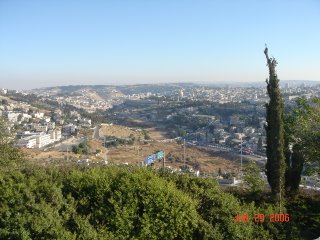
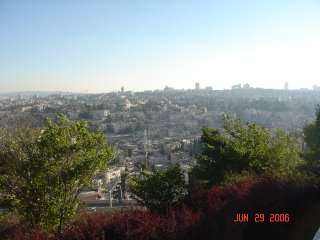
While I have pictures from my visit with my Israeli family, I've decided not to post them. Some things just aren't meant to be shared. Hopefully, you'll enjoy these shots of Jerusalem from Mount Scopus instead. And yes, I know the date stamps are a little off...

7.19.2006

Blundering Through Israel - Part V - June 30, 2006

I realize that this part of the world is in turmoil right now, as it has been for many of my past posts. Ultimately, I'll probably post my thoughts about it. But for now, I'm going to complete the series and let the intervening events take their course. That being said...

Continued from Part IV

Whenever I tell someone Jewish that I lived in the Washington, D.C. area, it's just a matter of time before I hear the question, "Did you go to the Holocaust Memorial Museum?" I explain that I have, complement the museum, and then, distinguish it from the Israeli Holocaust Memorial Museum, known as Yad Va'Shem (transl. "Hand of G-d").

While I am moved by the U.S. museum---and I don't want to take anything away from it, because it's not only important, but extraordinarily well done---the museum operates from the proposition that you know little about the Holocaust and educates in exacting detail. Yad Va'Shem, however, begins with the principle that you have some knowledge of the Holocaust and moves on from there. In many ways, Yad Va'Shem is much more visceral, more raw, more internal.

However, this feeling was an eight year old memory for me, because I had never been to the renovated museum at Yad Va'Shem.

But now that I have, that feeling I had from eight years ago is even more true.

Yad Va'Shem is heart-wrenching, fascinating, emotionally exhausting, and extraordinary, all at the same time. While I could tell many stories about it, I'm going to limit myself to two.

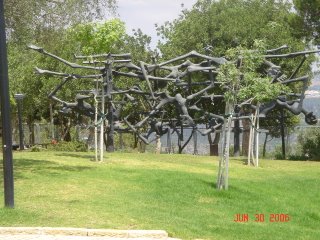
The first is about the trees at Yad Va'Shem, which you can see in this picture.


Yad Va'Shem has a number of carob trees on the museum property. Each of these trees is dedicated to a person. Not a benefactor (at least in the traditional sense), but a "Righteous Among the Nations." This title is preserved for individuals (and one country, Denmark) that, for no personal benefit and at the risk of their own lives, save one or more Jews from the hands of the Nazis. Each tree has this Righteous person's name on a plaque in front of it.

But the reason Yad Va'Shem chose carob trees is that it takes seventy years to bear fruit. Like the carob tree (and the Talmudic stories about it), the Righteous never saw the children and grandchildren and great-grandchildren that blossomed from the people they saved. And yet, for no reason other than their own humanity, they risked their lives to save the Jewish people one at a time.

The other story is of the Hall of Names.

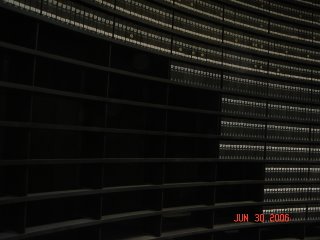
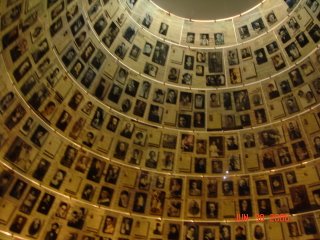
The Hall of Names is at the end of Yad Va'Shem. The Hall surrounds you with shelves upon shelves of books with the word Yizkor (transl. "Remember"). Contained within the books are three million names of Jews who were slaughtered by the Nazis.

However, despite the Nazis' meticulous record-keeping, and as a result of their widespread desire to annihilate the Jews, many entire families were simply wiped out. There's simply no record of those lost families, no one to tell their names to Yad Va'Shem.

So while the Hall of Names has over three million people memorialized in its volumes, it has many empty shelves. Those shelves serve as a perpetual memorial for those three million Jews whose names will never be known.

As you can see, even a picture of some of those empty shelves tells more than anything I can write here.


And the collage of pictures above reminds you, that these aren't just names, but people.


Each name was a life. A mother, a father, a child, a grandparent, a grandchild. A person with hopes, dreams, aspirations. A person whose future was snuffed out with less care than a candle. And, ultimately, for no reasons other than hate and apathy.

While the Holocaust is and will always remain an indelible and profound part of my Jewish identity, the lessons are far more universal. One lesson is still inscribed at Yad Va'Shem and is attributed to Pastor Martin Niemeller:

When the Nazis came for the communists, I remained silent; I was not a communist.

When they locked up the social democrats, I remained silent; I was not a social democrat.

When they came for the trade unionists, I did not speak out; I was not a trade unionist.

When they came for the Jews, I did not speak out; I was not a Jew.

When they came for me, there was no one left to speak out.

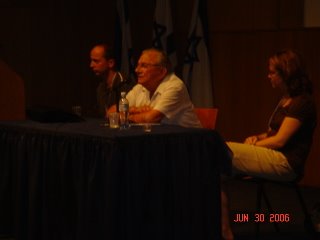
This is Jackie Hendeli, a Greek Jew from Saloniki and Holocaust survivor, whose incredible story included nine days in an overstuffed cattle car with no water on his way to Auschwitz, the indescribable torture ofAuschwitz, and the Nazi death marches at the end of the war, I simply could never do justice...

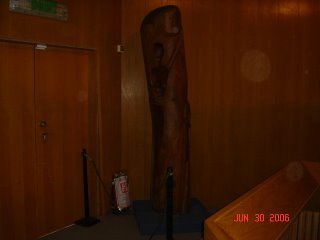
My favorite sculpture; a woman whose children are holding on to her, but have been cut out of her body...
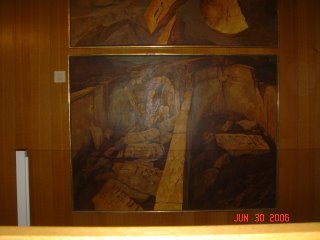
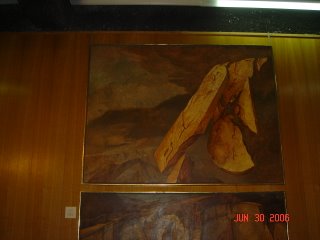
More artwork from Yad Va'Shem...
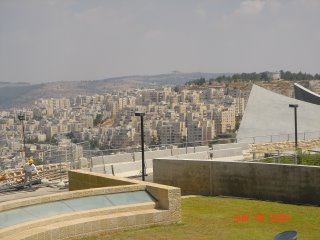


And the reminder of eternal hope that the view of Jerusalem inspires upon leaving...

7.16.2006

Blundering Through Israel - Part IV - June 29, 2006

Continued from Part III.

My father has been to Israel many times. One of the reasons is the city of Or Akiva. Or Akiva is a poor city in central Israel near rather wealthy areas, such as Ceaseria. The city serves as the home of many new immigrants who come to Israel, often with little money.

After Israel's founding, Or Akiva was in very poor shape. The city had an extremely high crime rate and considerable drug problems. It also lacked any viable infrastructure. The homes were in extraordinary disrepair and there was no viable sewage treatment. In fact, much of the city had raw sewage in the streets.

The American Jewish community stepped in to help. Through various methods, they contributed money to improve infrastructure and made sweeping changes in Or Akiva. And when the situation in Or Akiva stabilized, much of the community moved along to other Israel projects.

Except Miami.

Miami stayed, realizing there was much work to be done in Or Akiva and has spent the last thirty years making widespread and incredibly significant contributions to Or Akiva. And to this day, Miami serves as Or Akiva's sister city.

For the past seventeen years, I've heard my father discuss projects related to Or Akiva. He's been involved, in one way or another, with almost every major project related to the city. And the organizations he's involved with make, not only financial contributions, but send employees to live in the city and manage the use of the contributions to address the community's needs. However, while I've heard of Or Akiva often, it had always just been the name of an Israeli city.

Until today.

Today, I visited Or Akiva for the first time. I toured the older part of the city and saw some dilapidated houses that we learned were the example of how the entire city used to look. Then we went to the rest of the city.

The improvement of thirty years of investment was exponential in scale. The entire city, while still certainly having a way to go, was simply not even comparable to the dilapidated few houses that were examples of the city three decades before. Certainly, this was still a poor city, but one where investment bore hope and where its citizens discovered opportunity.

The jewel of Or Akiva is its schools. Prior to the Miami Jewish community's help, the schools in Or Akiva were some of the worst in Israel. Graduation rates were abysmal and students had very little opportunity for success.

But today they are the gem of the city. The schools are so good that the wealthy community of Ceaseria, where parents could send their children anywhere for school, send their children to Or Akiva's schools.

We went to a school for at-risk children and celebrated their completion of their year with them. The kids loved the toys we brought, but were even more enamored with the digital cameras that everyone in my group had. One even asked me if he could keep mine.

As we joked later, those kids have expensive taste!

My favorite story of Or Akiva and Miami is an older one. Or Akiva was scheduled to become a city in 2001. A Miami contingent came to Or Akiva to join the residents for this momentous occasion.

The dedication ceremony was set for commence at 4:00 p.m. on September 11, 2001.

The Miami group was loaded on their buses at 4:00 p.m. Israel time to go to the ceremony.

Then the cellphones began ringing.

When the Miami group realized what was happening---that America had been viciously attacked by terrorists---they unloaded the buses, when to a television and watched the events unfold. The Or Akiva dedication ceremony was delayed.

The residents of Or Akiva were beside themselves.

Here were these people who had provided so much help to them for over a quarter century and now their homes were under siege.

So the residents of Or Akiva did what Jews do.

They brought food.

Lots of food.

And they were there for the Jews of Miami in their hour of need.

And later that afternoon, when the time for the city's rescheduled dedication ceremony, the people of Or Akiva made clear that the ceremony could wait until another day. But the Miami group decided that the dedication was why they were there and that it was incredibly important to the people of Or Akiva.

So the ceremony went on.

And now, the Or Akiva dedication plaque reads September 11, 2001.


The Or Akiva Community Center...

A gift to Or Akiva from Miami...


Our party with the kids...

Our visit to the Tishbi winery. Such great wine!


Some shots of Ceaseria...


An unfinished sarcophogus...

More ancient ruins in Ceaseria...


The palace in the sea. The square in the middle was a freshwater pool...

Where the chariot races happened. A la Ben Hur...

The Ceaseria bathhouse false floor. Wood would be burned underneath to make a sauna...

One of the beautiful Ceaseria mosaics...


More ancient Roman ruins in Ceaseria...

7.10.2006

Blundering Through Israel - Part III - June 28, 2006

Continued from Part II.

The first full day in Israel was just that. A full day.

The day began with rafting down the Jordan River (sorry, no pictures, couldn't risk getting the camera wet), followed by a nature hike in the Golan Heights, by the Jordan. Hopefully, the pictures from the hike will offer a sense of the incredible beauty of northern Israel. As the area that provides two-thirds of the nation's fresh water, it is an incredibly lush part of the country. And even though I'm the "indoorsey" type, I feel like more than a visitor---like I was always meant to be here.

After our time at the Jordan, we went to Sfadt (pronounced Tza-fat, with short a's). Sfadt is renowned for its mystical history as the origin place of Madonna-made-famous Kabballah. It also houses a large orthodox Jewish community and a community of Jewish artists---two communities that don't always coexist well together.

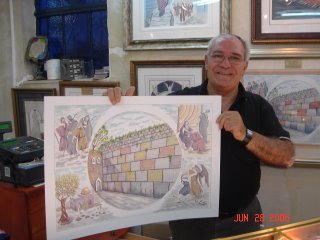
The most well-known art in Sfadt, other than its candles, is its microcaligraphy art. In these paintings, entire sections of the Bible are inscribed into watercolors paintings of biblical scenes as the lines of the pictures.

I knew I desperately wanted one of these paintings showing the biblical scene of Jacob wrestling the Angel, but I didn't anticipate I would find one. I walked into one gallery and the artist/owner said, "I see your name tag. What is your hebrew name?"

I told him and he said, "I have a painting of your biblical namesake. Here, let me show you."

He pulled open a drawer and took out an amazing pience of art. "Look," he said, pointing to the top corner, "Your namesake, with his brothers."

But then I looked at the bottom and there, in the lower right hand corner, was a picture of Jacob wrestling the Angel.

And as I looked closely at the lines that made up Jacob I saw a very familiar part of the Torah.

The part I read sixteen years earlier.

My parsha. My bar mitzvah Torah portion.

Admittedly, I'm not the most religious Jew, but that rite of passage still holds a special place in my heart.

And now, sitting in front of me was a beautiful painting with my parsha and my namesake.

I had to have it.

For the first time in a long time, price really was no object.

And I still got a pretty good deal.

So now I have a cardboard cylinder that both reminds me of a fantastic city and allows me to display two important parts of myself.

Money very well spent.


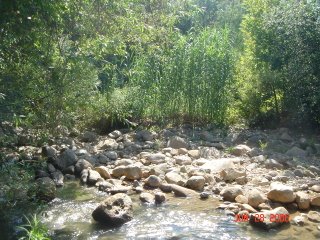
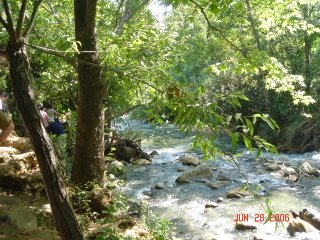
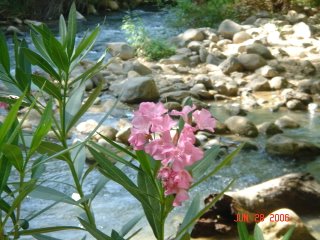
Some shots of the nature hike in the Jordan River, by the Golan Heights...


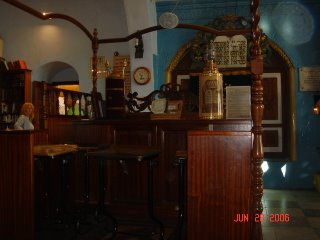
An old synagogue in Sfadt...


My infamous painting...

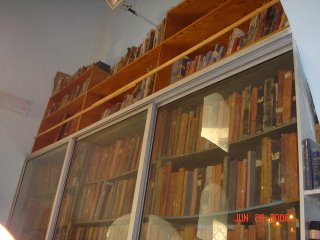
More pictures from Sfadt...